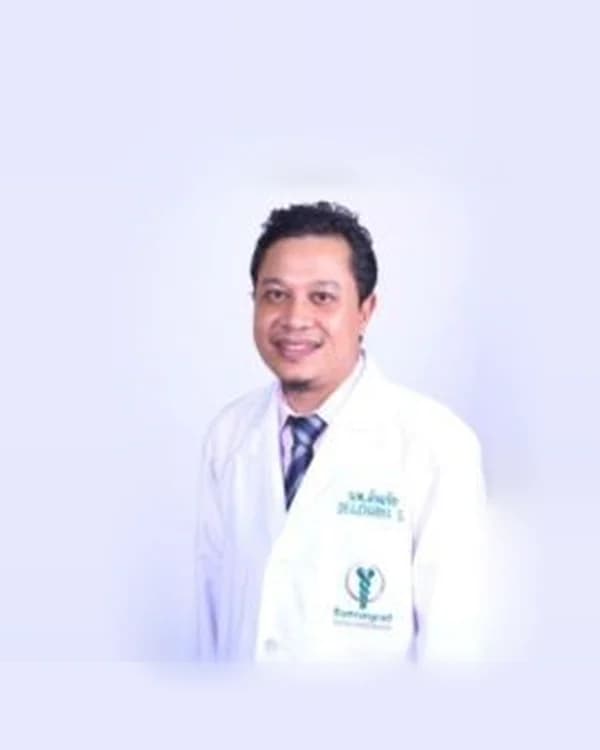
Key facts
- Specialty
- Oculoplastic surgery (ophthalmology)
- Subspecialties
- Orbital and Ophthalmic Plastic and Reconstructive Surgery
- City
- Bangkok, Thailand
- Practises at
- Vejthani Hospital
- Medical school
- Phramongkutklao College of Medicine
- Languages
- English, Thai
- Procedures
- 2 documented procedures
Dr. Khanchai Juangphanich: oculoplastic surgeon at Vejthani Hospital, Bangkok
Dr. Khanchai Juangphanich is an eye doctor (ophthalmologist) whose published subspecialty is orbital and ophthalmic plastic and reconstructive surgery, commonly called oculoplastic surgery. The field covers the eyelids, the skin and muscle surrounding the eye and the bone cavity it sits in, called the orbit. On this site Dr. Khanchai is listed as an oculoplastic surgeon in Bangkok.
The practice we can document is Vejthani Hospital. The hospital's own doctor page places Dr. Khanchai in its Eye Centre. Vejthani is a private hospital in Bangkok; the Bangkok city page puts it in context if you are weighing up destinations.
Under "Procedure Performed", that hospital page names blepharoplasty (eyelid surgery), ptosis surgery (lifting a drooping upper eyelid) and entropion-ectropion surgery (repositioning an eyelid that turns inward or outward). Our directory connects Dr. Khanchai to blepharoplasty and ptosis correction.
A word on what kind of specialist this is. The training on record is in ophthalmology, followed by a certificate in orbital and ophthalmic plastic surgery. The hospital does not present Dr. Khanchai as a general plastic surgeon, and nothing we hold connects the doctor to operations on the rest of the face or the body. That makes this a sensible person to ask about eyelid concerns, particularly those where the health of the eye itself is part of the question, and not a choice for a broad cosmetic package.
The same hospital page also mentions cataract, glaucoma and squint care. These are medical eye services rather than cosmetic surgery, so they fall outside what this site covers, but they show that the doctor's work spans general ophthalmology as well as eyelid surgery.
If you would like to ask about eyelid surgery with Dr. Khanchai, you can request a consultation. A member of our team reviews every enquiry, and nothing is booked automatically.
Education and training
- Medical degree1978
Doctor of Medicine (M.D.)
Phramongkutklao College of Medicine, Thailand
Source (vejthani.com) (opens in a new tab) - Board certification1990
Diplomate Board of Ophthalmology
Pramongkutklao College of Medicine, Thailand
Source (vejthani.com) (opens in a new tab) - Certificate1993
Certificate of Orbit, Ophthalmic Plastic and Reconstructive Surgery
Kellogg EC, USA
Source (vejthani.com) (opens in a new tab)
The details below are drawn from the Vejthani Hospital doctor page, which is the single source we could read for education. We last checked it on 2 October 2026.
- Doctor of Medicine (M.D.), Phramongkutklao College of Medicine, Thailand, 1978. The basic medical degree.
- Diplomate, Board of Ophthalmology, Pramongkutklao College of Medicine, Thailand, 1990. Specialist qualification as an eye doctor. The hospital page spells the institution slightly differently here than in the line above; we reproduce both as published.
- Certificate of Orbit, Ophthalmic Plastic and Reconstructive Surgery, "Kellogg EC", USA, 1993. The page abbreviates the institution, and we have not expanded the abbreviation. This is the additional training behind the oculoplastic work.
Read in order, this is a medical degree, then a specialist qualification in ophthalmology, then focused study of the eyelids and orbit. For a patient it signals an eye specialist who went on to concentrate on the structures around the eye, which is a separate pathway from general plastic surgery.
The licence can be looked up on the Medical Council of Thailand's public register at checkmd.tmc.or.th, and our patient team can help you confirm it before you travel. The hospital page also lists no professional society memberships. Neither point suggests a problem; they are simply not documented in what we could read. Before any treatment, it is reasonable to ask the hospital to confirm the doctor's licence and specialist board status in writing. Our methodology page explains how provider information is researched and labelled.
Professional experience
Only one role is documented: Dr. Khanchai works as an ophthalmologist, specialising in orbital and ophthalmic plastic and reconstructive surgery, at the Eye Centre of Vejthani Hospital, Bangkok.
The hospital page carries no start date, no previous posts, no academic roles and no count of operations performed, and we found none of these elsewhere. For that reason we do not state years in practice, case volumes or results. The only dates available are those attached to the qualifications (medical degree 1978, ophthalmology board 1990, orbital and oculoplastic certificate 1993), and they are the only timeline we can responsibly offer.
Experience matters with eyelid surgery, and it is fair to raise it. At a consultation you can ask how often the surgeon carries out the exact operation you need, what recovery usually looks like and how any problem after you return home would be handled. Our general advice on choosing a surgeon points to the same questions.
Procedures performed
Procedures are listed only when an official source, such as a hospital or clinic profile, a department page or the surgeon's own site, names them. A listing is not a recommendation: whether a procedure suits you is decided at a consultation.
Facial plastic surgery
Where these listings come from
- Listed under 'Procedure Performed': Blepharoplasty, Ptosis, Entropion-Ectropion Surgery vejthani.com (opens in a new tab)
- Listed under 'Procedure Performed': Ptosis surgery vejthani.com (opens in a new tab)
Eyelid and ptosis surgery with Dr. Khanchai: documented practice areas
### Blepharoplasty in Bangkok
Blepharoplasty is the first item on the hospital's list of procedures. As general background, blepharoplasty takes away or moves excess tissue (skin, muscle and fat) from the upper or lower lids. On the upper lid it can reduce hooding and, if the lid droops far enough to obstruct the top of your view, may help you see better. On the lower lid it targets under-eye bags. In general, upper-lid incisions follow in the natural crease, while work on the lower lid may use a cut just beneath the lashes or, for some patients, through the inside of the lid (transconjunctival), so that no scar shows on the skin.
Because Dr. Khanchai is an ophthalmologist, an eyelid consultation can be a natural setting for eye-related questions: conditions such as dry eyes, glaucoma and thyroid eye disease, or any change in sight, all affect whether surgery is safe and suitable. The hospital page does not describe how these are handled in practice, so put the questions to the doctor directly.
Related guides on this site cover upper eyelid surgery, lower eyelid surgery and the double eyelid crease operation. The doctor's listing says blepharoplasty without naming each variation, so do not assume a particular crease-forming technique is offered. Ask which approach would be recommended for your lids, and why.
### Ptosis surgery
Ptosis means the margin of the upper eyelid sits lower than it should. Generally it is not the same issue as loose skin, because the lid-lifting muscle needs repair and skin removal alone does not address it; our eyelid guide notes that surgeons look for it during assessment. Ptosis surgery is named explicitly on Dr. Khanchai's hospital page, which is the only evidence we have for it.
One useful question to bring is whether your droop comes from the muscle, from excess skin or from both, and what would be done in each case. If the lid also narrows what you can see, mention that as well.
### Entropion and ectropion surgery
The hospital page additionally names entropion-ectropion surgery. With entropion the lid edge folds inward and the lashes rub the eye; with ectropion the lid edge falls outward. These are mainly functional problems and sit comfortably within oculoplastic work. This site has no dedicated page on them, and we make no statement about the methods used. If you have a lid that turns, irritates the eye or leaves it watering constantly, say so when you make your enquiry.
What to discuss at an eyelid consultation with Dr. Khanchai
The list below is general guidance for eyelid and ptosis surgery, arranged around the procedures the hospital attributes to Dr. Khanchai. It is not an account of how this doctor conducts appointments, because we have no source for that.
Your goal. Decide whether you mainly want a cosmetic change (less hooding, smoother lower lids, a defined crease), a functional gain (clearer upper vision, a lid that opens normally) or both. Surgeons generally plan differently for each.
Eye health history. Bring up dry eyes, glaucoma, thyroid eye disease, earlier eye operations, contact lens use and any care you receive from an eye doctor at home. Our procedure guide lists several of these among the points patients are asked about, since they influence safety.
Whether the brow is involved. A brow lift can suit some patients better when the eyebrow itself has sagged, according to our guide. Ask whether your sense of heaviness comes from the lids, the brow or both.
Technique and anaesthesia. As a general pattern in Thailand, eyelid surgery is often performed with local anaesthetic plus sedation, and general anaesthesia may be offered instead. Ask what is planned for your case and where the operation would take place.
Risks. Our guide names dry or irritated eyes, brief blurred vision, difficulty shutting the eyes completely, unevenness between the sides, noticeable scars, a lower lid dragged downward and infection as possible problems, with bleeding behind the eye affecting sight described as very rare. Find out which are most relevant to your own anatomy and how each would be recognised and treated. After surgery, urgent help is needed for severe pain or if your vision is lost.
Recovery and follow-up. As general guidance from our blepharoplasty page, stitches come out at around 5-7 days, most bruising fades in 1-2 weeks, and final shape and scars settle over weeks to months. That timetable is a general one and your own may differ after assessment. Ask when you will be reviewed, who will check you before you fly and what happens if a concern arises once you are home.
Cost. The hospital page we read gives no prices and we quote none. Ask for an itemised written quote that lists the inclusions and exclusions. The total moves with the number of lids treated, the method chosen, the type of anaesthesia and any combined operation.
Hospitals and clinics where Dr. Khanchai Juangphanich practises
Bangkok
Vejthani Hospital
โรงพยาบาลเวชธานี อินเตอร์เนชันแนล
- Private hospital
- International patient service
Vejthani International Hospital is a private hospital in Bangkok, open since 1994, with a Plastic Surgery Center on its 11th floor, an international referral division and a hospital-listed JCI accreditation. Request a consultation through our patient team.
Accreditation
- JCI
- Surgeons
- 13
- Procedures
- 12
- Beds
- 263
- Established
- 1994
- Languages
- Over 20 languages through the hospital translator team (individual languages not listed on the page read)
Surgeons here




International patients
Vejthani Hospital is a Bangkok private hospital; its website says it opened in 1994 and has 263 beds, and its accreditations page shows JCI for 2025-2028. Those are the hospital's statements, so confirm them with the hospital before you travel.
Vejthani lists a Referral and Aviation Division for patients from abroad, with help on visas, flights and hotels, plus a V-Flight service that companions can use as well. The hospital's about-us page also says its translator team covers more than 20 languages, without listing them.
As for Dr. Khanchai personally, the hospital page lists English and Thai. Treat that as the documented position. When you send an enquiry, check that explanations, consent forms and aftercare instructions will be provided in a language you are comfortable with.
Vejthani also has a separate Plastic Surgery Center on the 11th floor, described on its own page. We have no evidence that Dr. Khanchai's work runs through that centre, since the doctor's page places the work in the Eye Centre. Ask which clinic and floor your appointment will be in.
Travel planning follows the general pattern for eyelid surgery. Our blepharoplasty guide says international patients commonly plan on 5-7 days in Thailand, covering stitch removal and a check of the lids. Your surgeon will advise on eye drops for the flight. Build your dates around that review and not only around the operation day.
Published by the hospitals and clinics
These services are offered and provided by each facility itself, as listed on its official site.
Vejthani Hospital
- International patient desk
- Referral and Aviation Division: visa extension, travel arrangement, hotel reservation and V-Flight service for patients and companions Source (vejthani.com) (opens in a new tab)
- Team of translators covering over 20 languages Source (vejthani.com) (opens in a new tab)
Languages listed: Over 20 languages through the hospital translator team (individual languages not listed on the page read)
How our patient team helps
- We pass your request to the surgeon's hospital or clinic and confirm availability, usually within one working day.
- You receive a booking reference to track your request.
- We answer practical questions on WhatsApp and by email.
ThaiCosmeticSurgery.com does not provide medical care. Treatment, prices and patient services are the responsibility of the hospital or clinic.
How to request a consultation with Dr. Khanchai Juangphanich
The place to begin is the enquiry page for Dr. Khanchai on ThaiCosmeticSurgery.com. Our patient team will get in touch and check what is possible with the hospital. Nothing is reserved until we have spoken with the hospital and confirmed the details with you.
A few details make the first reply much more useful:
- the change you want, or the problem you need treated (for example a heavy upper lid, a drooping lid or a lid that turns);
- whether you prefer a first online conversation or an in-person visit to Bangkok;
- when you could be in Thailand and for how many days;
- any eye condition or previous eye surgery.
Using our service costs you nothing. If you are still comparing options, Vejthani Hospital is a good page to read first.
A request is not a confirmed appointment until our patient team confirms it with you.
What to send before an eyelid or ptosis consultation
Gathering information beforehand helps the first conversation go further. For eyelid and ptosis questions it generally helps to have the following ready:
- Photographs. Even lighting, eyes open and looking straight ahead, plus a side view and one looking slightly up. Take glasses off and skip heavy eye make-up. If a droop developed over time, an older photo from before it began can be informative.
- Eye history. Any diagnosis of dry eye, glaucoma, thyroid eye disease, squint or cataract, plus eye drops or other medicines you use. A recent letter from your own eye doctor is valuable if you have one.
- Earlier surgery and treatments. Details of previous eyelid or eye operations, and any cosmetic injections around the eyes or brows.
- General health. Medicines (blood thinners especially), allergies, smoking and other conditions, because these influence anaesthesia and healing.
- Priorities. In brief: what bothers you, the result you picture and how subtle you want it.
- Travel plans. The dates available for a Bangkok trip and your latest return date.
Please do not put original documents or payment details into a general enquiry. Our team will explain how to share records securely and which ones the hospital needs.
Credential research
Every fact on this profile comes from a source we opened and dated. Where a source only states something, we say so.
- Medical Council of Thailand licence
- Check the Medical Council's public register (opens in a new tab)
- Profile last reviewed
Hospital and clinic affiliation
Education and training
Medical information
This profile is for information only and is not medical advice. Whether a procedure is suitable for you can only be decided after an assessment by a qualified surgeon. Every operation carries risks, and results vary from person to person. Before you commit to treatment, check the surgeon's credentials yourself, for example on the Medical Council of Thailand register. We do not accept payment for placement or rankings.
Frequently asked questions
Who is Dr. Khanchai Juangphanich?
An ophthalmologist whose published subspecialty is orbital and ophthalmic plastic and reconstructive surgery (oculoplastic surgery). Vejthani Hospital's doctor page places Dr. Khanchai in its Eye Centre in Bangkok.
Where does Dr. Khanchai Juangphanich practise?
The documented practice is Vejthani Hospital in Bangkok. We have not searched for or verified any other practice. More is on the [Vejthani Hospital page](/hospital/vejthani-hospital/).
Does Dr. Khanchai perform blepharoplasty?
The hospital page lists blepharoplasty among the procedures performed. General background is on our [blepharoplasty page](/procedures/blepharoplasty/). Ask which technique the doctor would recommend for your lids.
Does Dr. Khanchai perform ptosis surgery?
Ptosis surgery is on the hospital's list. Ptosis is a drooping upper eyelid margin, which generally needs muscle repair and not skin removal alone; an assessment would show which applies to you.
Does Dr. Khanchai treat entropion and ectropion?
The hospital page lists entropion-ectropion surgery, which addresses eyelids that turn inward or outward. These are often functional rather than cosmetic problems. We hold no further detail on how they are treated.
What training does Dr. Khanchai have?
Per the hospital page: a medical degree (M.D.) from Phramongkutklao College of Medicine (1978), the Diplomate Board of Ophthalmology (1990) and a Certificate of Orbit, Ophthalmic Plastic and Reconstructive Surgery from "Kellogg EC" in the USA (1993).
Is Dr. Khanchai a plastic surgeon?
Dr. Khanchai's listed field is ophthalmology with oculoplastic subspecialty training; it is not general plastic surgery. The listed procedures are limited to the eyelids, so for operations elsewhere on the face or body you would need a different surgeon.
Which languages does Dr. Khanchai speak?
The hospital page lists English and Thai. When you enquire, check that your appointment and aftercare instructions will be in a language you are comfortable with.
Has Dr. Khanchai's licence been verified?
Not yet. No licence number is shown on this profile; the licence can be looked up on the Medical Council of Thailand's public register at checkmd.tmc.or.th. Please ask the hospital for written confirmation of registration before treatment.
How do I request a consultation?
Submit your details on the [enquiry page](/book/?doctor=khanchai-juangphanich). A team member answers and checks availability at the hospital, so the form does not create a reservation by itself.
What should I send before the first consultation?
Well-lit photos of your eyes from the front, side and slightly above, a summary of eye conditions and earlier surgery, your medicines and allergies, the change you want and your travel window.
What length of stay should I plan for eyelid surgery?
The usual stay on our blepharoplasty page is 5-7 days, which allows time to remove stitches and review healing. Dr. Khanchai's own advice may differ and will depend on the procedure you have.