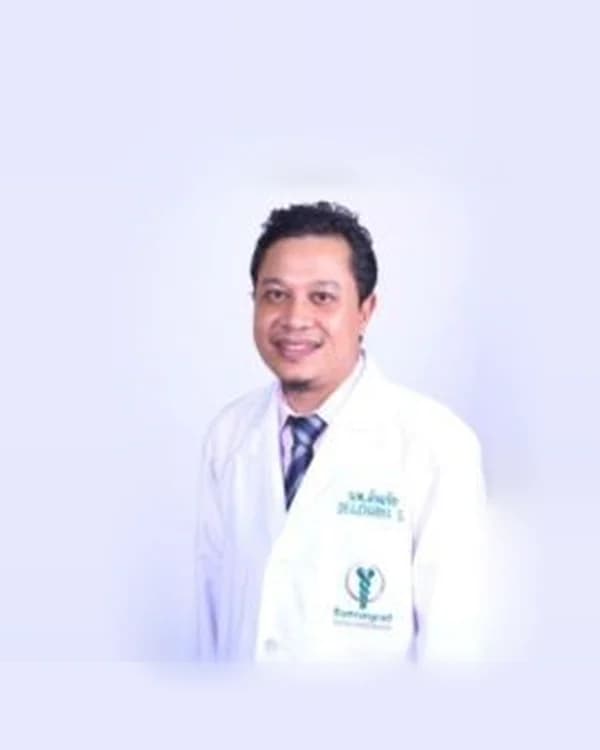

Key facts
- Specialty
- Oculoplastic surgery (ophthalmology)
- Subspecialties
- Orbit and Oculoplastic surgery
- City
- Bangkok, Thailand
- Practises at
- Phyathai 2 Hospital
- Medical school
- Faculty of Medicine, Chulalongkorn University
- Residency and fellowship
- Chulalongkorn University
Dr. Fonthip Na Pombejara: oculoplastic surgery at Phyathai 2 Hospital, Bangkok
Dr. Fonthip Na Pombejara is an ophthalmologist, which means a medical doctor who specialises in the eye, working in Bangkok, Thailand. The doctor's page on the Phyathai 2 Hospital website puts Dr. Fonthip in the hospital's Eye Center and gives the area of expertise as Orbit and Oculoplastic surgery. Within ophthalmology, oculoplastic surgery is the part that handles the eyelids, the tear drainage system, the bony socket around the eyeball (the orbit) and the soft tissues that surround them.
Why does that background matter to someone considering eyelid or eye-area surgery? Because an oculoplastic surgeon arrives at this work through eye medicine rather than through general plastic surgery. The training centres on how the lids protect and move over the eye, so the surgeon looks at the surface of the eye and the working of the lids, not only at the outline of the face. If your concern sits around the eye, that is a reasonable reason to put an oculoplastic specialist on your shortlist alongside plastic surgeons.
The hospital where this surgeon is listed, Phyathai 2 Hospital, is a private hospital at 943 Phaholyothin Road in the Phayathai district of Bangkok. Our Phyathai 2 Hospital page gathers what we have verified about the facility, and the Bangkok page covers the city.
What the public profile leaves out. The hospital page does not state a gender, spoken languages, society memberships, a start date, past appointments or a list of operations. We have therefore written none of those things. Where a patient would normally want the answer, we say it is unpublished and suggest raising it when you submit a request. Our provider research methodology page explains how profiles like this one are assembled and checked.
Education and training
- Medical degree2001
Doctor of Medicine (M.D.)
Faculty of Medicine, Chulalongkorn University, Thailand
Source (phyathai.com) (opens in a new tab) - Residency2008
Ophthalmology
Chulalongkorn University, Thailand
Source (phyathai.com) (opens in a new tab) - Fellowship2009
Oculoplastic and reconstructive subspecialty training
Chulalongkorn University, Thailand
Source (phyathai.com) (opens in a new tab) - Board certification
Diploma of the Thai Board of Ophthalmology
Thai Board of Ophthalmology, Thailand
Source (phyathai.com) (opens in a new tab) - Board certification
Diploma of the Thai Subspecialty Board of Oculoplastic Surgery
Thai Subspecialty Board of Oculoplastic Surgery, Thailand
Source (phyathai.com) (opens in a new tab)
Everything in this section comes from one source: the Phyathai 2 Hospital doctor page, the only official profile we could open. That page gives each training period in Thai Buddhist-era years. We converted the end year of each period to the common-era calendar, so the dates below are the conversions rather than figures printed on the page.
- Medical degree: M.D. (Doctor of Medicine) awarded by Chulalongkorn University's medical faculty, finishing in 2001.
- Ophthalmology residency: at Chulalongkorn University, completed in 2008.
- General specialty board: Diploma of the Thai Board of Ophthalmology.
- Oculoplastic subspecialty training: oculoplastic and reconstructive training at Chulalongkorn University, completed in 2009.
- Subspecialty board: Diploma of the Thai Subspecialty Board of Oculoplastic Surgery.
Read as a sequence, the page describes medical school, then several years of eye-specialist residency, then a shorter further period devoted to oculoplastic and reconstructive work, with a board diploma listed at each of the two specialty levels. The profile places all of this training in Thailand and names no overseas fellowship.
Independent licence confirmation. Patients are right to want confirmation outside the hospital's own website. No licence number is shown on this profile; the licence can be looked up on the Medical Council of Thailand's public register at checkmd.tmc.or.th. Likewise, the Thai plastic surgery societies' member lists were also out of reach, and the hospital profile states no society membership of its own. If this check matters to you, ask our patient team to confirm the details with the hospital before you book flights. The method behind our checks is on the methodology page.
Professional experience
Only a single position is documented. Dr. Fonthip Na Pombejara is listed at Phyathai 2 Hospital, Bangkok, as an ophthalmologist in the Eye Center, with special expertise in orbit and oculoplastic surgery.
Nothing further is published on the page. We have no start date, no earlier hospital posts, no teaching appointments and no authorship record: a search of the medical literature databases turned up no articles we could tie to this name and workplace with confidence. For that reason we make no estimate of years in practice, and we give no count of operations performed. If experience is central to your decision, the questions worth putting to the surgeon directly are how often the specific operation you are considering features in regular practice and how complications are handled afterwards.
One structural detail is worth knowing. The hospital files this surgeon under the Eye Center, not under the Beauty Center, which is the hospital's home for cosmetic laser and plastic surgery services. In practice that suggests an eye-medicine setting. Eyelid and orbital problems frequently sit alongside other eye conditions, and a patient who also has dry eye, glaucoma or thyroid-related eye changes may find it useful that the surgeon works inside an eye department, where those conditions are part of everyday work. We are describing a plausible advantage in general terms, not reporting something the profile says.
Practice areas: orbit and oculoplastic surgery
The only documented practice area is orbit and oculoplastic surgery. The hospital page names no individual operation, and we have not linked this surgeon to any procedure page on our site. Everything below is general background on the field, offered so you know what to ask. None of it states that Dr. Fonthip performs a particular operation.
### What the oculoplastic field generally covers
In general, oculoplastic surgeons treat the eyelids, the tear ducts, the orbit and the skin and soft tissue around the eyes. People come to this kind of care with drooping lids, loose skin that overhangs the lashes, bags beneath the eyes, lids that have shifted position after injury or earlier surgery, and conditions of the bony socket. Part of the work is functional or reconstructive, for example when heavy upper lids cut into the field of vision, and part is cosmetic.
### Topics patients commonly raise about the eye area
People researching cosmetic work near the eyes often start with blepharoplasty (eyelid surgery), and then look at the versions of it: upper eyelid surgery, lower eyelid surgery and double eyelid surgery. Our procedure pages explain the split. Upper and lower operations deal with surplus skin and fat, double eyelid surgery creates or refines the crease, and ptosis correction addresses a lid margin that sits too low because of the lifting muscle, not because of extra skin. Whether Dr. Fonthip offers any of these is unconfirmed, since the public profile is silent.
### Why lid skin and lid position are not the same question
An upper lid can look heavy for several reasons: surplus skin, a low lid margin, a brow that has settled downward, or more than one of these together. Each calls for a different operation, so the order of examination matters. Surgeons trained in eye medicine commonly check the lid margin and the surface of the eye while they assess. When you contact us, say which complaint bothers you most, whether it is the look of the area, the way it feels, or both, so that the first question put to the surgeon is the right one.
### Questions to bring about any operation
- Does this operation form part of the surgeon's usual work at Phyathai 2 Hospital?
- Which anaesthetic would be planned, and why?
- How are tear production, eyelid closure and vision tested before surgery and again afterwards?
- Who deals with follow-up if something changes once you are back home?
What to expect at a consultation about eye and eyelid concerns
Since no procedures are documented for this surgeon, the most productive consultation begins with your concern and lets the surgeon say what is and is not suitable. The points here are general to oculoplastic consultations. They do not describe how Dr. Fonthip runs appointments, which we have not been told.
An eye history will probably be taken. In general, an oculoplastic assessment asks about watery or dry eyes, glaucoma, thyroid eye disease, contact lenses, earlier eye or eyelid operations, injuries and any recent change in sight. Our blepharoplasty page says these conditions affect how safe eyelid surgery is, which is why such questions are routine rather than unusual.
Talk about how the eyes work, not only how they look. If the lids feel weighty, if you lift your chin to see, or if reading tires your eyes, mention it. Function can change the operation under consideration.
Raise the alternatives. If it is the eyebrow that has sunk, a brow lift can be a better match than taking away lid skin on its own, and some concerns do not call for surgery. You should leave the appointment able to explain why one option was suggested over another.
Get the risks explained in the surgeon's words. Our blepharoplasty page lists these possible complications: irritated or dry eyes, blurred vision for a time, trouble closing the lids fully, uneven results, scars that remain visible, a lower lid pulled down out of position and infection. It also names an uncommon bleed behind the eye that can threaten sight. Intense pain or any sudden loss of vision after an operation calls for urgent medical help. Ask how each problem would be recognised and handled, and whether suitability for you can only be judged after a personal examination, which is the honest answer in almost every case.
Plan the trip around the surgeon's advice. On the general blepharoplasty guidance we publish, people travelling from abroad often plan 5–7 days in the country, because stitches are taken out around that point, and most bruising settles over 1–2 weeks. Those are broad figures; the surgeon sets your actual schedule. Ask what has to be checked before you fly and what to do if something feels wrong at home.
Hospitals and clinics where Dr. Fonthip Na Pombejara practises
Phyathai 2 is a private hospital on Phaholyothin Road, Bangkok. Its Beauty Center includes the Phyathai Plastic Surgery Center. Request a consultation through our patient team.
- Surgeons
- 16
- Beds
- 550
- Established
- 1987
Surgeons here

International patients
Phyathai 2 Hospital is a private hospital in Bangkok. The hospital's official site records 1987 as its founding year and a capacity of 550 beds. The hospital's Beauty Center, home to its plastic surgery and cosmetic laser services, is on the fourteenth floor of Building B, with listed opening hours of 9 am to 8 pm every day. The Beauty Center page gives the hospital call centre as 1772 or +66 2 617 2444.
There are three cautions. First, those Beauty Center contacts belong to the plastic surgery and laser service. Dr. Fonthip is listed under the Eye Center, so the route to an appointment may be different, and our patient team can find out the right one. Second, we found no accreditation statement naming a body and date for the hospital, so we do not claim one. Third, no list of languages or interpreter services is published for this surgeon or the Eye Center; if you need an interpreter, raise it in your request before you travel.
For wider trip planning, our Bangkok page and the Phyathai 2 Hospital page are the places to start.
Published by the hospitals and clinics
These services are offered and provided by each facility itself, as listed on its official site.
Phyathai 2 Hospital
- International patient desk
- Line Official (@pt2_inter) and WeChat (PT2Chinese) contact channels listed for the Beauty Center Source (phyathai.com) (opens in a new tab)
How our patient team helps
- We pass your request to the surgeon's hospital or clinic and confirm availability, usually within one working day.
- You receive a booking reference to track your request.
- We answer practical questions on WhatsApp and by email.
ThaiCosmeticSurgery.com does not provide medical care. Treatment, prices and patient services are the responsibility of the hospital or clinic.
How to request a consultation with Dr. Fonthip Na Pombejara
The way in is the request form for this surgeon on ThaiCosmeticSurgery.com. What you submit goes to our patient coordinators, who check with Phyathai 2 Hospital whether a time is possible and then reply to you. Submitting does not hold a place in the diary; a date exists only after our team has confirmed it in writing.
A short message is enough to begin. Say which concern you want to discuss, whether it is about appearance, function or both, which travel dates are possible, and whether you would like an online conversation before deciding to travel. If you cannot tell whether an eye specialist or a plastic surgeon is the better first call, tell us that too. We can help you compare, and you can see other surgeons on the Bangkok page.
Prefer to begin with the hospital rather than a named doctor? A hospital-level request form is available too.
A request is not a confirmed appointment until our patient team confirms it with you.
What to send before a consultation about your eyes or eyelids
Putting the right details in a first message speeds up the reply. The list below is general guidance for oculoplastic enquiries, not a list the hospital has asked for.
- Clear photographs. Take them face-on in even light with your eyes open and relaxed, then one from each side and one with your gaze lifted slightly. Keep a natural expression and leave off heavy eye make-up.
- Older photographs. A picture from some years back, if you have one, shows whether a droop or bag has appeared recently or has always been there.
- Eye background. Your glasses or contact lens prescription, and any diagnosis such as glaucoma or dry eye, and any thyroid condition.
- Earlier operations. Any previous eyelid, eye or facial operation, with rough dates, the country of the surgery and operative notes if you kept them.
- Medicines and allergies. Include blood thinners, eye drops and supplements.
- What you hope for. Two or three sentences about the change you want and any concern you have about an operation.
- Travel window. The dates when you could be in Bangkok and the longest you could stay.
Add these through the request form. Send only what you are happy to share; the team will say which items are truly needed.
Credential research
Every fact on this profile comes from a source we opened and dated. Where a source only states something, we say so.
- Medical Council of Thailand licence
- Check the Medical Council's public register (opens in a new tab)
- Profile last reviewed
Hospital and clinic affiliation
Education and training
Medical information
This profile is for information only and is not medical advice. Whether a procedure is suitable for you can only be decided after an assessment by a qualified surgeon. Every operation carries risks, and results vary from person to person. Before you commit to treatment, check the surgeon's credentials yourself, for example on the Medical Council of Thailand register. We do not accept payment for placement or rankings.
Frequently asked questions
Who is Dr. Fonthip Na Pombejara?
Dr. Fonthip Na Pombejara is an ophthalmologist in the Eye Center of Phyathai 2 Hospital, Bangkok. The hospital profile lists a stated expertise in orbit and oculoplastic surgery, a field covering the eyelids, the eye socket and the tissues around them.
Where does Dr. Fonthip Na Pombejara practise?
The one documented place of practice is Phyathai 2 Hospital, 943 Phaholyothin Road, Phayathai District, Bangkok. We located no other hospital listing for this surgeon.
What training is listed for Dr. Fonthip Na Pombejara?
According to the hospital profile, the surgeon took a Doctor of Medicine at Chulalongkorn University (2001), then ophthalmology residency at the same university (2008), then oculoplastic and reconstructive training (2009). It also lists diplomas of the Thai Board of Ophthalmology and the Thai Subspecialty Board of Oculoplastic Surgery. Years are our conversions from the Buddhist calendar.
Does Dr. Fonthip Na Pombejara perform eyelid surgery or blepharoplasty?
We cannot say. The public profile names the field of orbit and oculoplastic surgery but no individual operations. Eyelid surgery is a normal part of oculoplastic work in general, so we can put your specific operation to the hospital. For background, see the [blepharoplasty page](/procedures/blepharoplasty/).
Is Dr. Fonthip Na Pombejara a plastic surgeon?
Not according to the profile. It describes an ophthalmologist with oculoplastic subspecialty training who is placed in the hospital's Eye Center, not its Beauty Center. We therefore label the specialty oculoplastic surgery within ophthalmology rather than general plastic surgery.
Can I use your site to ask for a visit with this eye surgeon?
Yes: send the [request form](/book/?doctor=fonthip-na-pombejara). Our coordinators check with the hospital and report back on what is possible; a submitted form does not itself book a time.
What photos and details should I include with my enquiry?
Face-on and side photographs with relaxed eyes, older pictures if you have them, your eye history (prescription, glaucoma, dry eye, thyroid problems), any earlier eye or eyelid surgery, current medicines and allergies, what you hope to change, and possible travel dates.
Does Dr. Fonthip Na Pombejara speak English?
The hospital profile gives no spoken languages, so we cannot confirm English or any other language. Tell us in your request which language you need and our team will ask the hospital how a consultation could be arranged.
Is Dr. Fonthip Na Pombejara licensed and board certified?
The hospital profile lists diplomas of the Thai Board of Ophthalmology and the Thai Subspecialty Board of Oculoplastic Surgery. No licence number is shown on this profile; the licence can be looked up on the Medical Council of Thailand's public register at checkmd.tmc.or.th. Ask our team to confirm it before you travel.
How many days should I plan to be away from home?
That depends on the assessment and on any treatment. Our general blepharoplasty guidance mentions 5–7 days in Thailand as a common length of stay for eyelid surgery, ending when stitches are removed. Your surgeon decides the real plan, so treat that range as a rough guide only.